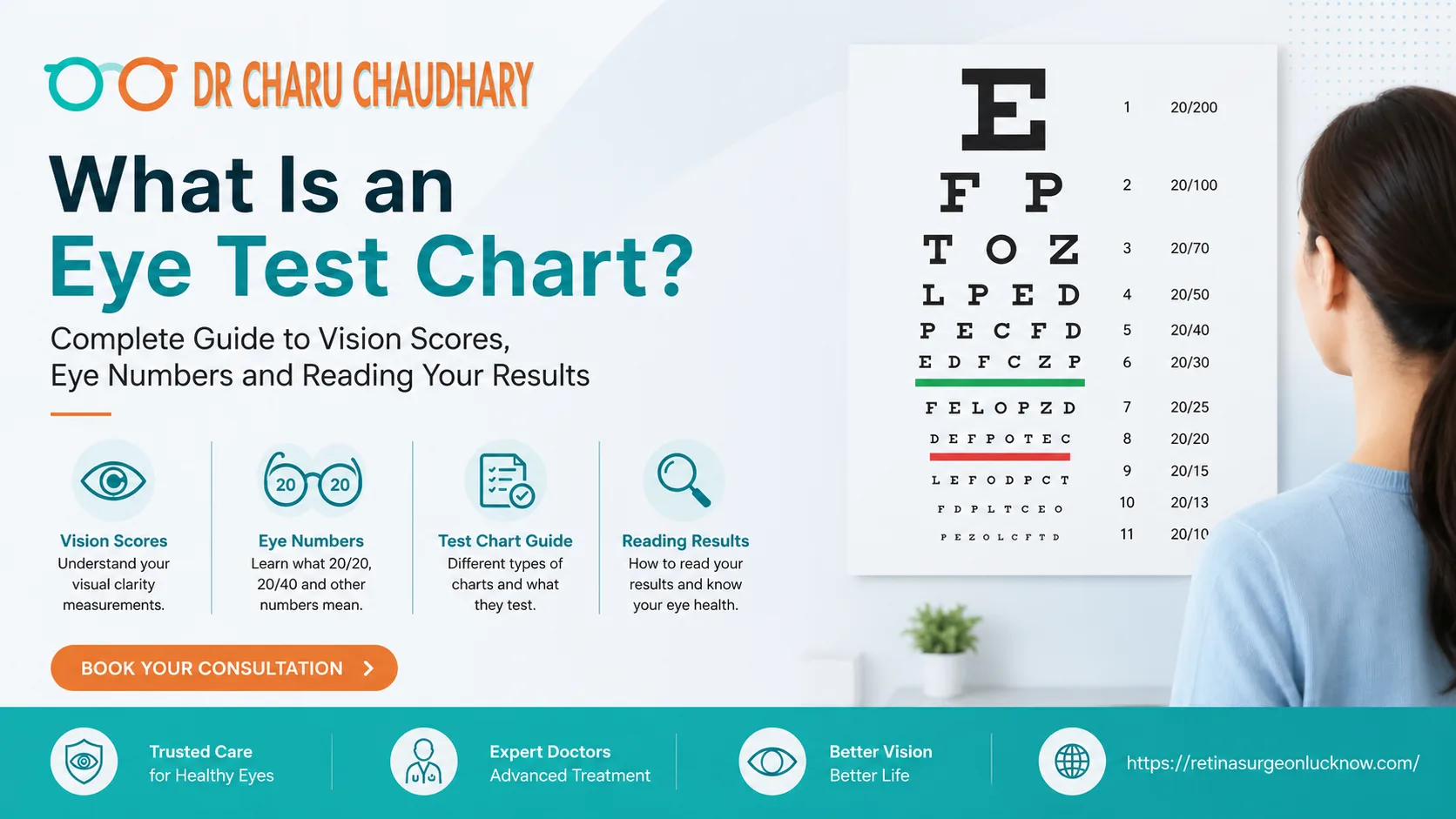
An eye test chart, most commonly the Snellen chart, is a clinical tool used by eye specialists to measure visual acuity and sharpness. During an eye exam, patients read rows of letters or symbols from a specific distance to determine their vision score, such as 20/20 or 6/6. These charts help doctors identify vision errors and determine if glasses or further medical treatments are necessary. Have you ever sat in a dim exam room, covering one eye, and trying to read a line of letters that seem to shrink as they go down? Most of us have encountered the classic “E” chart at some point. As an eye specialist, I, Dr. Charu Chaudhary, find that while many people have taken this test, very few actually understand what the results mean. “Does a minus number mean I’m going blind?” or “Is 20/20 vision perfect health?” are questions I hear daily. Understanding your vision shouldn’t be a mystery. This guide is designed to simplify the Snellen chart, decode those confusing eye numbers, and help you interpret your eye reports with confidence. Quick Summary If you are looking for a fast overview of vision scores, here are the essentials: What Is an Eye Test Chart? At its core, an eye test chart is a standardized way to measure “visual acuity.” Visual acuity refers to the sharpness or clarity of your vision at a specific distance. When you visit a clinic, we use these charts to determine if your eyesight meets the “normal” standard or if you have a refractive error that requires correction. The chart consists of various rows of “optotypes”—specially designed letters or symbols. While the chart looks simple, it is a scientifically calibrated tool. Each row represents a different level of visual ability. If you can read the small lines at the bottom, your brain and eyes are working together efficiently to process fine detail. The Snellen Chart — The Gold Standard of Vision Testing The most recognizable eye test chart in the world is the Snellen Chart. Developed in 1862 by Dutch ophthalmologist Herman Snellen, it remains the primary tool used by eye specialists like myself. How the Snellen Chart Works The chart typically features a large letter “E” at the top, followed by rows of letters that get progressively smaller. In my practice, I use the Snellen chart not just to prescribe glasses, but as a “vital sign” for the eye. A sudden drop in your ability to read the Snellen lines can alert us to underlying issues like cataracts or retinal changes. 6 Types of Eye Test Charts — Which One Is Right for You? While the Snellen chart is the most famous, eye specialists use various charts depending on the patient’s age and specific needs. 1. The Classic Snellen Chart Used for adults and children who know the alphabet. It uses a specific set of 10 letters (C, D, E, F, L, N, O, P, T, Z) known as Snellen optotypes. 2. The Tumbling E Chart This is used for people who cannot read the alphabet or for young children. The patient simply indicates which direction the “fingers” of the letter E are pointing (up, down, left, or right). 3. Landolt C Chart Similar to the Tumbling E, this chart uses a circle with a gap (like the letter C). The patient identifies where the gap is located. It is often used in international research for its high level of accuracy. 4. Pediatric Charts (LEA Symbols) For very young children, we use symbols like houses, apples, and hearts. This allows us to test a child’s vision before they even learn their ABCs. 5. Near Vision Charts (Jaeger Chart) This is a small, hand-held card used to test how well you see up close. It is essential for diagnosing “Presbyopia,” the age-related loss of near-focusing ability that usually begins after age 40. 6. Pelli-Robson Contrast Sensitivity Chart This chart doesn’t just measure size; it measures how well you can see objects against a background. This is crucial for patients with glaucoma or those who struggle with night driving. 📊Vision Score Chart — What Is a Normal Eye Test Reading? What does your score actually say about your eyesight? Here is a simple breakdown of common Snellen chart readings. Vision Score (Feet) Vision Score (Metric) Meaning 20/20 6/6 Normal Vision: You see at 20ft what a normal person sees at 20ft. 20/15 6/4.5 Excellent Vision: You see better than the average person. 20/40 6/12 Mild Blur: Most states require at least this for a driver’s license. 20/70 6/21 Moderate Impairment: You may struggle to read standard print without help. 20/200 6/60 Severe Impairment: This is the threshold for legal blindness in many regions. What is a “good” eye test score? A score of 20/20 is the clinical standard for “good” vision. However, having 20/20 vision does not necessarily mean your eyes are perfectly healthy—it just means they are seeing clearly at a distance. What is a “bad” eyesight score? If your score is 20/50 or higher (the second number is larger), your vision is significantly limited. At this stage, everyday tasks like recognizing faces across a street or reading street signs become difficult. 📊How to Read Your Eye Test Results — Prescription Decoder After you finish reading the Snellen chart, your specialist will give you a prescription. These numbers can be confusing. Let’s decode them into patient-friendly language. Term What it Means Simple Explanation OD Oculus Dexter Your Right Eye. OS Oculus Sinister Your Left Eye. SPH (Sphere) The main power Minus (-) means Nearsighted; Plus (+) means Farsighted. CYL (Cylinder) Astigmatism This corrects the “football shape” of your cornea. Axis The Angle The direction (0–180°) the astigmatism correction is placed. ADD Reading Power The “extra” boost needed for reading (bifocals/progressives). How do I read my eye test results? If your report says OD: -2.00 SPH, it means your right eye is nearsighted and needs two diopters of correction to see the 20/20 line on the Snellen chart. If it says +1.50 SPH, you are farsighted, and your