
Vision is often considered our most precious sense, yet many of us take it for granted until it begins to fade. Among the various conditions that can threaten our sight, glaucoma stands out as one of the most mysterious and dangerous. Often called the “silent thief of sight,” glaucoma is a group of eye conditions that damage the optic nerve—the vital link between your eye and your brain.
Because this damage often happens slowly and without pain, millions of people worldwide are unaware they even have the condition until significant vision loss has occurred. Understanding the relationship between glaucoma and optic nerve health is the first step toward prevention. In this comprehensive guide, we will explore the mechanics of glaucoma optic nerve damage, why early detection is life-changing, and how experts like Dr. Charu Chaudhary are helping patients preserve their vision.
How Glaucoma Damages the Optic Nerve
Glaucoma causes optic nerve damage by increasing pressure inside the eye or reducing blood supply to the nerve fibers. Over time, this pressure crushes sensitive nerve cells, leading to permanent vision loss if the condition is not detected and treated early.
What Is Glaucoma? Understanding the Basics
At its core, glaucoma is not just a single disease but a category of ocular disorders characterized by progressive damage to the optic nerve.
Understanding Glaucoma in Simple Terms
Think of your eye like a sink with a faucet and a drain. The “faucet” produces a clear fluid called aqueous humor to nourish the eye. The “drain” (located at the angle where the iris and cornea meet) allows this fluid to leave. In a healthy eye, the production and drainage are balanced. In glaucoma, the drain gets clogged or works inefficiently, causing fluid to build up. This buildup increases pressure, which eventually pushes against the optic nerve.
How Common Is Glaucoma?
Glaucoma is a leading cause of irreversible blindness globally. According to the World Health Organization (WHO), it is the second leading cause of blindness after cataracts. However, unlike cataracts, which can be surgically “cured” to restore sight, the vision loss caused by glaucoma is permanent.
Why Glaucoma Is a Serious Eye Disease
The danger of glaucoma lies in its stealthy nature. In the most common form (open-angle glaucoma), there are no symptoms in the early stages. No pain, no redness, and no sudden blurring. By the time a patient notices a “tunnel vision” effect, up to 40% of the optic nerve fibers may already be destroyed. This is why Dr. Charu Chaudhary emphasizes that regular screenings are the only way to catch the thief before it steals your sight.
Can Glaucoma Cause Permanent Blindness?
Yes. If left untreated, glaucoma eventually destroys the entire optic nerve, resulting in total blindness. However, with modern medical interventions and early diagnosis by the Best Eye Specialist in Lucknow, the vast majority of patients can maintain functional vision for the rest of their lives.
What Is the Optic Nerve and Why Is It Important?
To understand glaucoma optic nerve damage, we must first understand what the optic nerve does.
How the Optic Nerve Connects the Eye to the Brain
The optic nerve is often described as the “electric cable” of the eye. It is composed of more than a million tiny nerve fibers (retinal ganglion cells). These fibers collect visual information from the retina (the light-sensitive tissue at the back of the eye) and transmit it to the brain.
How Visual Signals Travel
- Light enters the eye and hits the retina.
- The retina converts light into electrical impulses.
- These impulses travel along the million-plus fibers of the optic nerve.
- The brain receives these signals and interprets them as the images we “see.”
Why Healthy Optic Nerves Are Essential for Vision
Without a functional optic nerve, the eye and the brain cannot communicate. Even if your eye is perfectly healthy in every other way—clear lens, healthy retina, perfect cornea—you will be blind if the optic nerve is severed or destroyed. It is the “bridge” of sight.
What Happens When the Optic Nerve Gets Damaged?
When the fibers within the optic nerve begin to die, the “cable” loses its ability to transmit full images. Initially, the brain compensates for small gaps in the visual field. However, as more fibers die, the gaps become larger, leading to permanent blind spots.
How Does Glaucoma Cause Optic Nerve Damage?
The process of damage is complex and can involve several biological mechanisms.
1. Increased Eye Pressure (Intraocular Pressure – IOP)
High intraocular pressure is the most significant risk factor for glaucoma. When fluid (aqueous humor) cannot drain properly, the pressure inside the eye rises. This pressure exerts physical force on the optic nerve head (the point where the nerve leaves the eye). Over time, this mechanical stress compresses the nerve fibers and the tiny blood vessels that nourish them.
2. Reduced Blood Supply to the Optic Nerve
Some patients develop glaucoma even with “normal” eye pressure. This suggests that poor blood flow (ischemia) to the optic nerve also plays a role. If the blood vessels supplying the nerve are narrow or if blood pressure is too low, the nerve cells don’t get enough oxygen and nutrients, leading to cell death.
3. Damage to Retinal Nerve Fibers
The optic nerve is made of the axons of retinal ganglion cells. Glaucoma specifically targets these cells. The high pressure or low blood flow triggers a process called “apoptosis” or programmed cell death. Once these cells die, they do not regenerate.
4. Progressive Loss of Nerve Cells
The damage usually starts at the outer edges of the optic nerve, which corresponds to our peripheral (side) vision. As the disease progresses, the damage moves inward toward the center, eventually affecting central vision and leading to total blindness.
Why the Damage Is Usually Permanent
Unlike skin or bone, the nerve cells in the human central nervous system (which includes the optic nerve) do not have the capacity to regrow once they are dead. This is why glaucoma treatment focuses on “saving what’s left” rather than “restoring what’s lost.”
The Step-by-Step Process of Glaucoma Damage
Glaucoma is a journey of progression. Understanding these stages can help patients realize where they stand.
| Stage | What is Happening? | Impact on Vision |
| Stage 1: Increased Pressure | Fluid drainage slows down; IOP begins to rise. | No noticeable change; vision is 20/20. |
| Stage 2: Nerve Fiber Stress | Pressure begins to compress the nerve head. | Microscopic damage occurs; invisible to the patient. |
| Stage 3: Cell Death | Significant numbers of nerve fibers die. | Very small blind spots in peripheral vision. |
| Stage 4: Peripheral Loss | Large sections of the optic nerve are gone. | “Tunnel vision” begins; difficulty driving or walking. |
| Stage 5: Advanced Loss | Only the central fibers remain or all are lost. | Severe visual impairment or total blindness. |
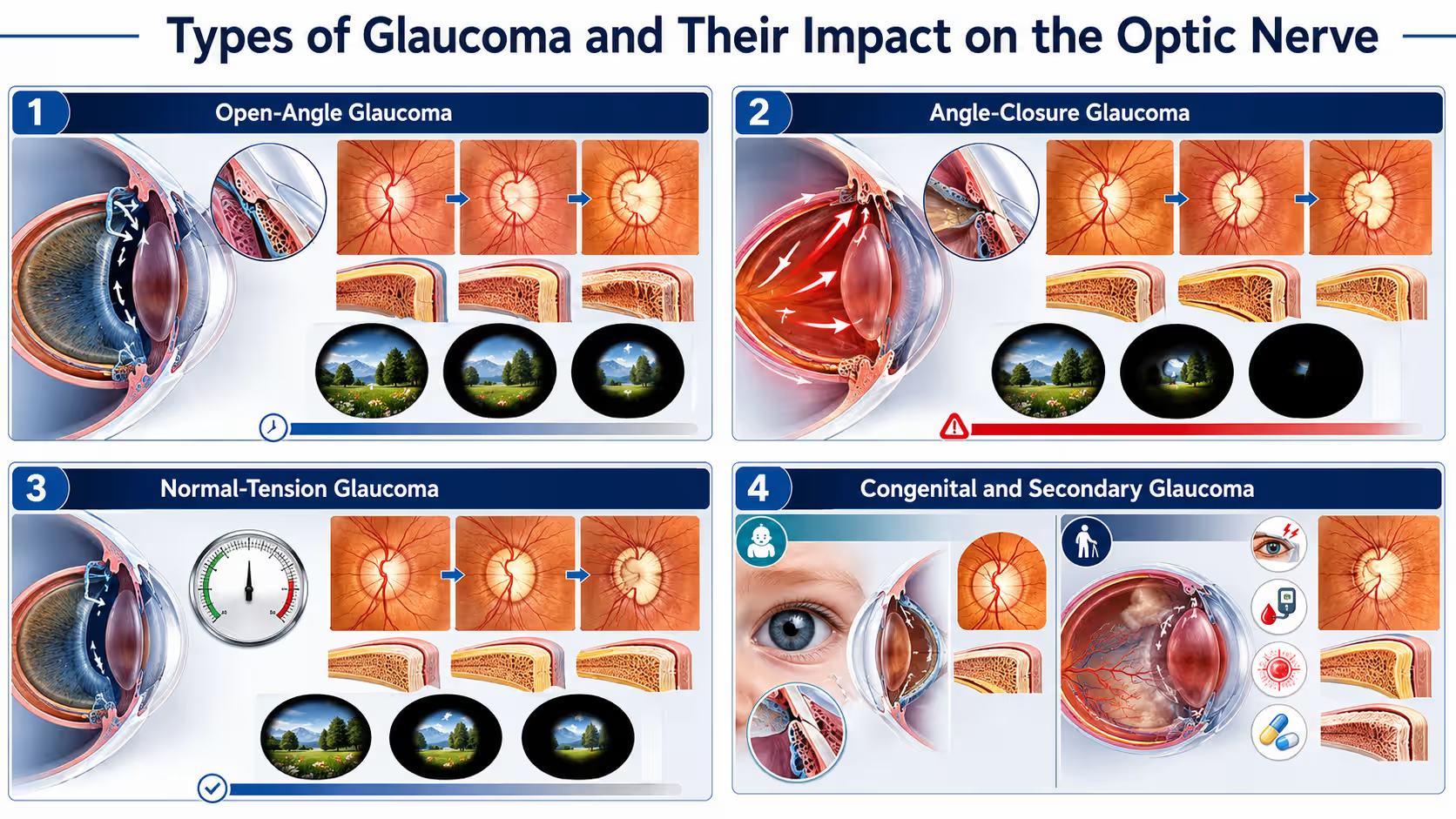
Types of Glaucoma and Their Impact on the Optic Nerve
Different types of glaucoma attack the optic nerve in different ways.
Open-Angle Glaucoma
This is the most common form. The “drain” of the eye remains open, but it becomes clogged over time, like a slow-moving pipe.
- Impact: The pressure rises slowly, and the optic nerve is damaged gradually over the years.
- The Catch: Because it’s painless and slow, patients often don’t seek help until the damage is severe.
Angle-Closure Glaucoma
This occurs when the iris is pushed forward, completely blocking the drainage angle. It is like a “sink” that is suddenly and totally plugged.
- Impact: Eye pressure spikes rapidly. This can cause massive optic nerve damage in a matter of hours.
- Medical Emergency: Symptoms include severe eye pain, nausea, and blurred vision. This requires immediate intervention by an eye specialist in Lucknow.
Normal-Tension Glaucoma
In this version, the optic nerve is damaged even though the eye pressure is within the “normal” range.
- Impact: This is often linked to poor blood circulation or an ultra-sensitive optic nerve.
Congenital and Secondary Glaucoma
- Congenital: Present at birth due to abnormal eye development.
- Secondary: Caused by other factors like eye injuries, long-term steroid use, or advanced diabetes.
Early Symptoms of Glaucoma You Should Never Ignore
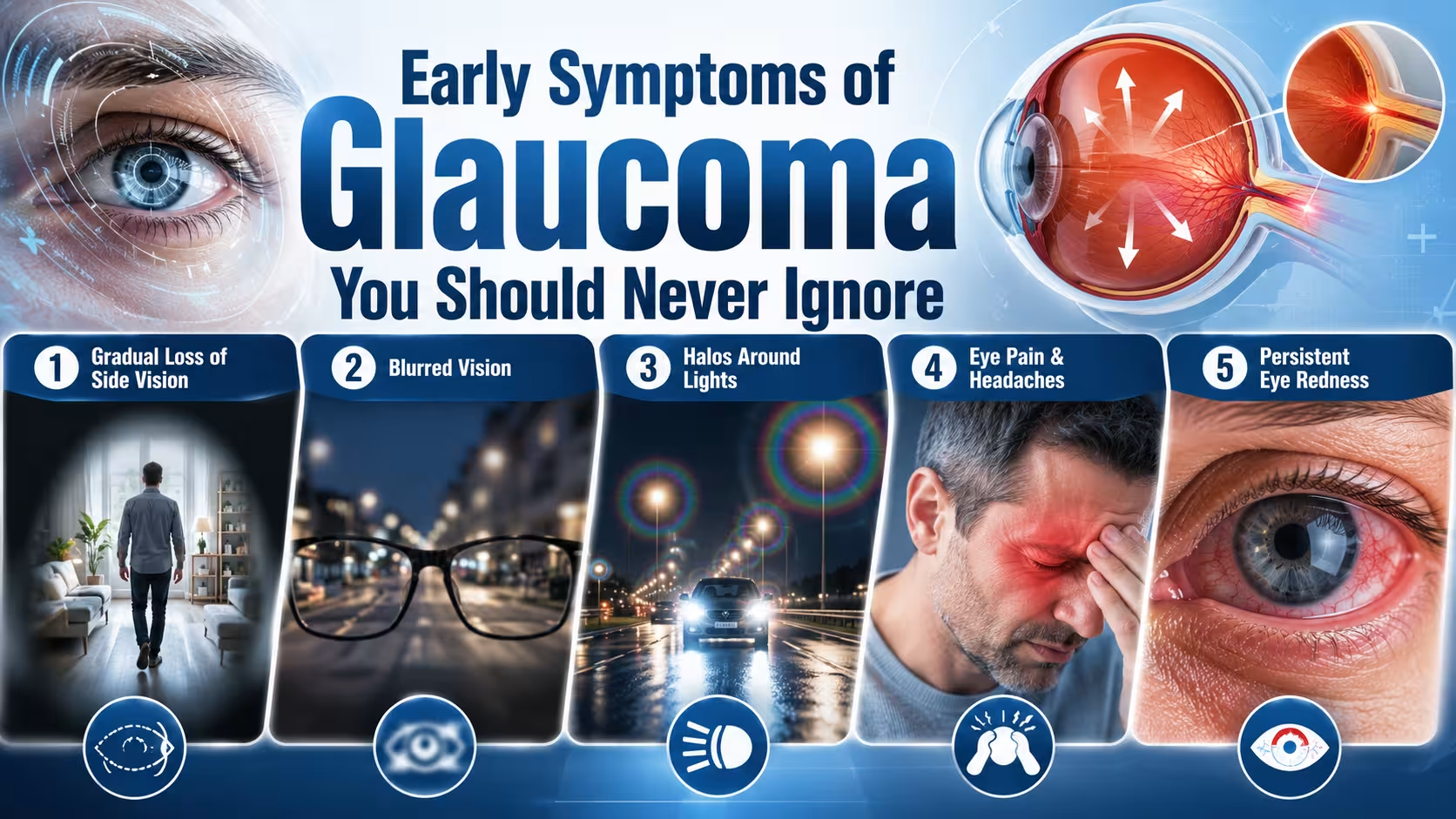
While early-stage glaucoma is often asymptomatic, keep an eye out for these “red flags”:
- Gradual Loss of Side Vision: You might feel like you have “blinders” on or notice you are bumping into furniture more often.
- Blurred Vision: Especially in the evening or in low-light conditions.
- Halos Around Lights: Seeing rainbow-colored circles around bright lights at night.
- Eye Pain & Headaches: Often associated with the acute pressure spikes of angle-closure glaucoma.
- Redness of the Eye: Persistent redness that doesn’t resolve with rest.
Why many patients have no symptoms: The brain is incredibly good at “filling in the blanks.” If one eye has a small blind spot, the other eye covers for it, and the brain merges the images. You only notice the loss when both eyes have significant damage.
Who Is Most at Risk of Developing Glaucoma?
Knowledge of your risk level is vital for glaucoma prevention.
- Age Over 40: Risk increases significantly as we age.
- Family History: If a parent or sibling has glaucoma, your risk is 4 to 9 times higher.
- Medical Conditions: Diabetes, hypertension (high blood pressure), and heart disease.
- High Eye Pressure: Individuals with naturally higher IOP need closer monitoring.
- Steroid Use: Long-term use of steroid eye drops or tablets can raise eye pressure.
- High Myopia (Nearsightedness): Highly nearsighted eyes have anatomical structures that make the optic nerve more vulnerable.
Can Optic Nerve Damage from Glaucoma Be Reversed?
One of the most difficult conversations Dr. Charu Chaudhary has with patients is explaining that optic nerve damage cannot be reversed.
Current medical science does not have a way to “re-awaken” dead nerve fibers. However, there is hope.
- Preserving Remaining Vision: If you lose 30% of your vision, modern treatment can help you keep the remaining 70% for the rest of your life.
- Early Detection is Key: The earlier you start treatment, the more “nerve tissue” you have to save. This is why an annual exam with the Best Eye Specialist in Lucknow is non-negotiable for those over 40.
How Doctors Diagnose Glaucoma and Optic Nerve Damage
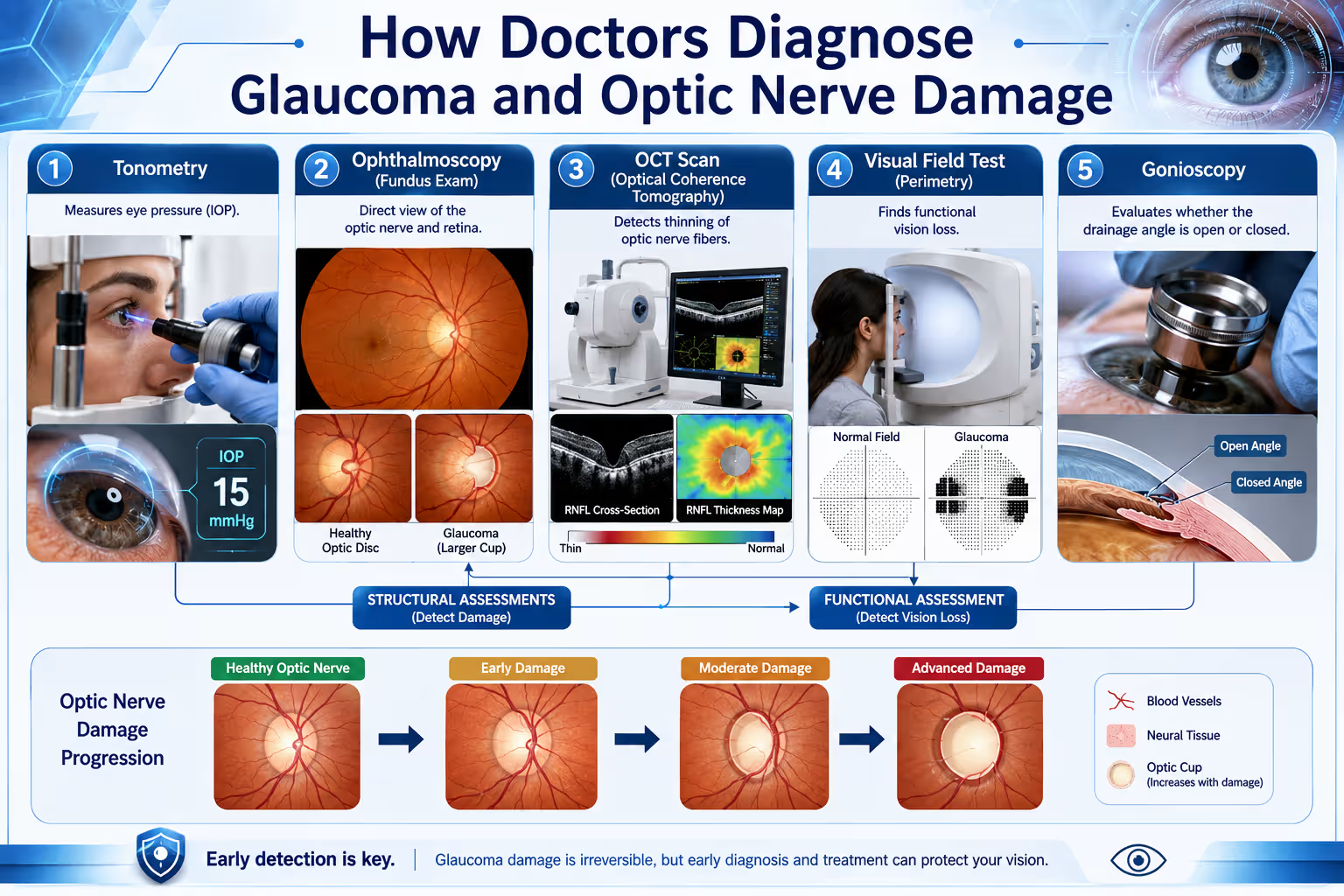
A simple “puff test” for eye pressure is not enough to diagnose glaucoma. A comprehensive exam involves:
- Tonometry: Measuring the internal pressure of the eye.
- Ophthalmoscopy (Fundus Exam): The doctor looks through the pupil to examine the shape and color of the optic nerve.
- OCT Scan (Optical Coherence Tomography): A high-tech 3D “ultrasound with light” that measures the thickness of the nerve fiber layer. Thinning indicates damage.
- Visual Field Test (Perimetry): This test maps your peripheral vision to see if you have any hidden blind spots.
- Gonioscopy: A special lens is used to see if the “drain” of the eye is open or closed.
Modern Treatment Options for Glaucoma
The goal of all glaucoma treatment is to lower eye pressure to a “target level” where no further optic nerve damage occurs.
1. Eye Drops
For most patients, daily medicated eye drops are the first line of defense. They either help the fluid drain better or reduce the amount of fluid the eye produces.
2. Laser Treatments
- SLT (Selective Laser Trabeculoplasty): A gentle laser used to “unclog” the drain in open-angle glaucoma.
- LPI (Laser Iridotomy): Used for angle-closure glaucoma to create a tiny hole in the iris, allowing fluid to flow freely.
3. Surgical Interventions
- Trabeculectomy: Creating a new drainage path for the eye fluid.
- Glaucoma Drainage Devices: Implantation of a tiny tube to shunt fluid out.
- MIGS (Minimally Invasive Glaucoma Surgery): Newer, safer procedures with faster recovery times for mild-to-moderate cases.
How to Protect Your Optic Nerve from Glaucoma Damage
Prevention and proactive management are your best tools.
- Get Regular Checkups: If you are over 40, get a comprehensive eye exam every 1–2 years.
- Follow Your Treatment Plan: If prescribed eye drops, use them every single day. Missing doses allows pressure to spike and damage the nerve.
- Know Your Family History: Talk to your relatives. If glaucoma runs in the family, start screenings earlier.
- Healthy Lifestyle: Regular exercise (like walking) can help lower eye pressure, though intense “head-down” yoga poses should be avoided by glaucoma patients.
- Protect Your Eyes: Use safety goggles; eye injuries can lead to secondary glaucoma.
Glaucoma Awareness in Lucknow
In a growing city like Lucknow, lifestyle changes and an aging population have led to a rise in eye health concerns. Glaucoma awareness remains low, with many residents attributing blurred vision to “just getting old” or simple cataracts.
Dr. Charu Chaudhary emphasizes that regular glaucoma screening is essential for the community. With access to advanced diagnostic technology like OCT and automated perimetry in Lucknow, there is no reason for anyone to lose their sight to this “silent” disease. As the Best Eye Specialist in Lucknow, Dr. Chaudhary focuses on early intervention—catching the disease at Stage 1 or 2 so that patients never have to experience the limitations of Stage 4 or 5.
When Should You See an Eye Specialist Immediately?
Do not wait for your scheduled appointment if you experience:
- Sudden, severe eye pain.
- A sudden “cloudy” or “steamy” quality to your vision.
- Nausea or vomiting accompanying eye pain.
- Seeing “halos” or “rainbows” around lights.
- A sudden “curtain” falling over your vision.
Conclusion
Glaucoma optic nerve damage is a serious, progressive condition that requires a proactive approach. Because the optic nerve is the “cable” that allows us to see the world, protecting it should be a top priority for everyone, especially those with risk factors like age, family history, or diabetes.
Remember:
- Glaucoma is often silent until it is advanced.
- The damage it causes is irreversible.
- Early detection via comprehensive eye exams is the only way to prevent blindness.
By staying informed and seeking regular evaluations from experienced professionals like Dr. Charu Chaudhary, you can ensure that the “silent thief” never steals your precious gift of sight.
CTA
Glaucoma is one of the leading causes of preventable blindness, but early diagnosis and consistent treatment can help preserve vision for years.
If you have risk factors for glaucoma, notice changes in your vision, or have a family history of eye disease, consult Dr. Charu Chaudhary for a comprehensive eye evaluation. Early care from an experienced Best Eye Surgeon in Lucknow can make a significant difference in protecting your eyesight. Don’t wait for symptoms to appear—book your screening today.
FAQs
1. How does glaucoma damage the optic nerve?
Glaucoma damages the nerve through high intraocular pressure (IOP) which physically compresses nerve fibers, or through poor blood flow which starves the nerve cells of oxygen. Both lead to cell death.
2. Can optic nerve damage from glaucoma be reversed?
No. Once the nerve fibers are destroyed, they cannot grow back. Treatment is designed to stop or slow down further damage.
3. What are the first signs of glaucoma?
In most cases, there are no first signs. In advanced stages, you may notice a loss of peripheral (side) vision or see halos around lights.
4. Does glaucoma always cause high eye pressure?
No. Some people have “normal-tension glaucoma,” where the optic nerve is damaged even though eye pressure is in the normal range.
5. Can glaucoma lead to blindness?
Yes. If left untreated, it can lead to total, irreversible blindness. However, with early treatment, most people retain their vision.
6. How often should glaucoma patients have eye checkups?
Typically, every 3 to 6 months, depending on the severity of the condition and how well the eye pressure is controlled.
7. What is the best treatment for glaucoma?
The “best” treatment depends on the individual. It usually starts with medicated eye drops, but may involve laser therapy or surgery if drops are not enough.
8. Who is most at risk for glaucoma?
People over 40, those with a family history of the disease, diabetics, and those with high degrees of nearsightedness.